

Views: 0 Author: Site Editor Publish Time: 2026-11-01 Origin: Site


Choosing the right cutting tool often determines the success of a complex machining project. Many shops struggle with premature tool failure, inconsistent surface finishes, and unexpectedly high per-part costs. This frustration usually stems from the assumption that a single tool can handle every material or geometry. In reality, there is no "universal" cutting solution available. Selecting the appropriate Solid Carbide End Mills requires aligning tool geometry, substrate composition, and protective coatings with the specific thermal and mechanical demands of your workpiece. This article provides an engineering-focused framework for evaluating your tooling options. We will move past basic marketing claims to focus on material removal rates, tool life predictability, and operational efficiency. You will learn how to match your equipment to the right tool, ensuring better results on every production cycle.
Solid carbide excels in applications under 3/4" (19mm) diameter requiring high precision, minimal deflection, and superior surface finishes.
Flute count and helix angle must be inversely matched to material hardness and chip clearance requirements.
Advanced coatings (like TiAlN or AlTiN) only provide ROI if machining parameters generate enough heat to activate their protective oxidation layers.
Machine rigidity and tool-holding runout dictate whether premium carbide tools will achieve their rated lifespan or shatter prematurely.
Defining your success criteria is the essential first step. You must decide if your primary goal is maximizing material removal rates, achieving specific dimensional tolerances, or extending tool life for unattended shifts. Each goal demands a different approach to tooling selection. Consider your workpiece material constraints carefully:
Non-Ferrous/Aluminum: These materials require high shear, large chip pockets, and polished flutes to prevent galling.
Steels/Alloys: These demand high edge strength, increased flute counts for stiffness, and thermal-resistant coatings.
Exotics (Titanium/Inconel): These necessitate specific geometries like variable pitch or variable helix to mitigate chatter and work-hardening.
Before purchasing new inventory, always audit your current failure modes. Are you seeing chipping, flank wear, or built-up edges? Identifying the specific failure type helps you choose the correct corrective variable, whether that involves changing the geometry or adjusting your feed rates.
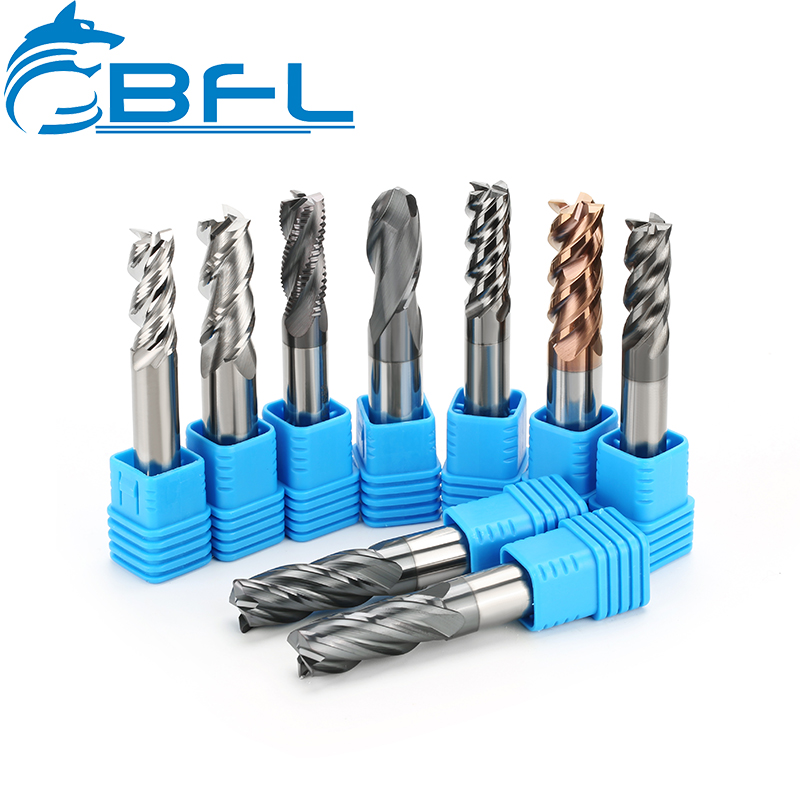
The industry standard provides a clear threshold for choosing between these two options. Solid carbide is generally the most cost-effective choice for diameters under 1/2" to 3/4". Once you exceed the 3/4" threshold, indexable tools often become more economical due to the replaceable nature of the inserts. Solid carbide eliminates issues related to insert runout. This makes it mandatory for finishing passes where tight dimensional tolerances or superior surface finishes are required. Additionally, evaluate your length-to-diameter ratio (L/D). If you are performing deep cavity milling, solid carbide provides the highest stiffness possible, which helps minimize tool deflection. The following table summarizes when to prioritize solid carbide over other options.
Selection Criteria Table
Application Type | Preferred Tool Type | Primary Benefit |
|---|---|---|
Finish Milling | Solid Carbide | High Precision |
Deep Cavity Milling | Solid Carbide | High Rigidity |
High-Volume Roughing (>3/4") | Indexable | Lower Replacement Cost |
Gummy Material Milling | Specialized Solid Carbide | Enhanced Chip Evacuation |
Flute count logic remains a fundamental aspect of tool design. Selecting the wrong flute count will immediately impact your chip removal performance.
2 to 3 Flutes: These designs offer maximum chip pocket volume. They perform best in gummy materials like aluminum or soft plastics.
4 to 6+ Flutes: These provide a larger core diameter for increased rigidity. They are ideal for harder materials and peripheral finishing passes.
Helix angle dynamics also play a significant role. A low, or slow, helix provides greater edge strength and lower axial forces. Conversely, a high, or fast, helix offers a sharper cutting edge and faster chip evacuation. Be aware that a high helix creates significant axial pull, which requires very secure workholding. For specific niche tasks, look into specialty profiles. While square and ball nose mills cover most jobs, roughers like corncob mills are vital for heavy material removal. You might also consider customized straight blade end mills, which are effective for routing plastics or specific edge finishing where you must neutralize lifting forces. Finally, remember that variable pitch or helix geometries are excellent for disrupting harmonic resonance and eliminating chatter during aggressive cuts.
Think of coatings as essential thermal barriers and lubricity aids rather than just simple wear protection. Matching the coating to the specific material will significantly extend your tool life. Common coating applications include:
TiN / TiCN: These are legacy baseline coatings. They work well for general purpose jobs but struggle at high temperatures.
TiAlN / AlTiN: These require heat to form a protective aluminum oxide layer. They are excellent for dry machining steels but can be counterproductive if you run them too slowly or use excessive coolant.
ZrN / TiB2: These offer high lubricity. They are mandatory for preventing built-up edges when cutting aluminum or non-ferrous materials.
Do not overlook the value of uncoated tools. For many plastics or non-ferrous applications, a highly polished, uncoated end mill often outperforms coated versions because edge sharpness matters more than thermal protection in these specific scenarios.
Premium solid carbide tools are incredibly hard, but this hardness makes them inherently brittle. A machine with excessive spindle runout will cause micro-chipping and eventual failure. Ensure your Total Indicator Reading (TIR) remains below 0.0005" to maintain optimal performance. Your choice of tool holder is equally vital. High-performance end mills cannot compensate for a low-rigidity holder. While standard ER collets are common, they often lack the clamping force required for aggressive operations. Hydraulic or shrink-fit holders provide the superior dampening and clamping needed to utilize high-performance geometry effectively. Always verify your machine's horsepower and torque capabilities. Micro-tooling projects often require high-RPM spindles, whereas heavy roughing requires high low-end torque. If your machine cannot sustain the necessary feeds and speeds, your investment in high-end carbide will not provide the expected returns.
Effective procurement shifts the focus from the price of a single end mill to the total cost per part. You should seek vendors who provide transparent speed and feed charts along with reliable batch-to-batch consistency. Avoid testing new tools during standard prototype runs where variables are difficult to control. Instead, isolate the tool in a controlled production run. This allows you to accurately measure cycle time reductions and tool wear rates. Keep a detailed log of tool changeover times and scrap reduction. When you analyze these metrics, you will find the most efficient tooling strategy for your specific shop environment.
A: Yes, re-sharpening is typically viable for tools with diameters over 1/2". However, you must ensure the service includes professional recoating to restore the original performance. Be aware that the tool diameter will be slightly reduced after sharpening, so you must update your CNC machine offsets accordingly to maintain dimensional accuracy.
A: You should choose a variable helix end mill when you are machining tough alloys, performing heavy slotting, or experiencing chatter and vibration. These tools use unequal spacing or angles to disrupt harmonic resonance, which helps you achieve a better surface finish and significantly extends tool life compared to standard geometry.
A: The choice depends entirely on your material and coating. For example, AlTiN coatings on steel often perform better with high-pressure air blast, as this prevents thermal shock. Conversely, aluminum machining requires a steady stream of coolant to prevent chips from welding to the cutting edge and creating a built-up edge.
A: Start by checking your spindle runout and assessing fixture stability. Monitor the process closely for vibration during initial entry. High-performance carbide is brittle and requires very rigid setups to survive. If you notice persistent chatter or vibration that you cannot eliminate through parameter adjustments, HSS or powdered metal tools may serve as a safer, more reliable fallback for your specific machine.


