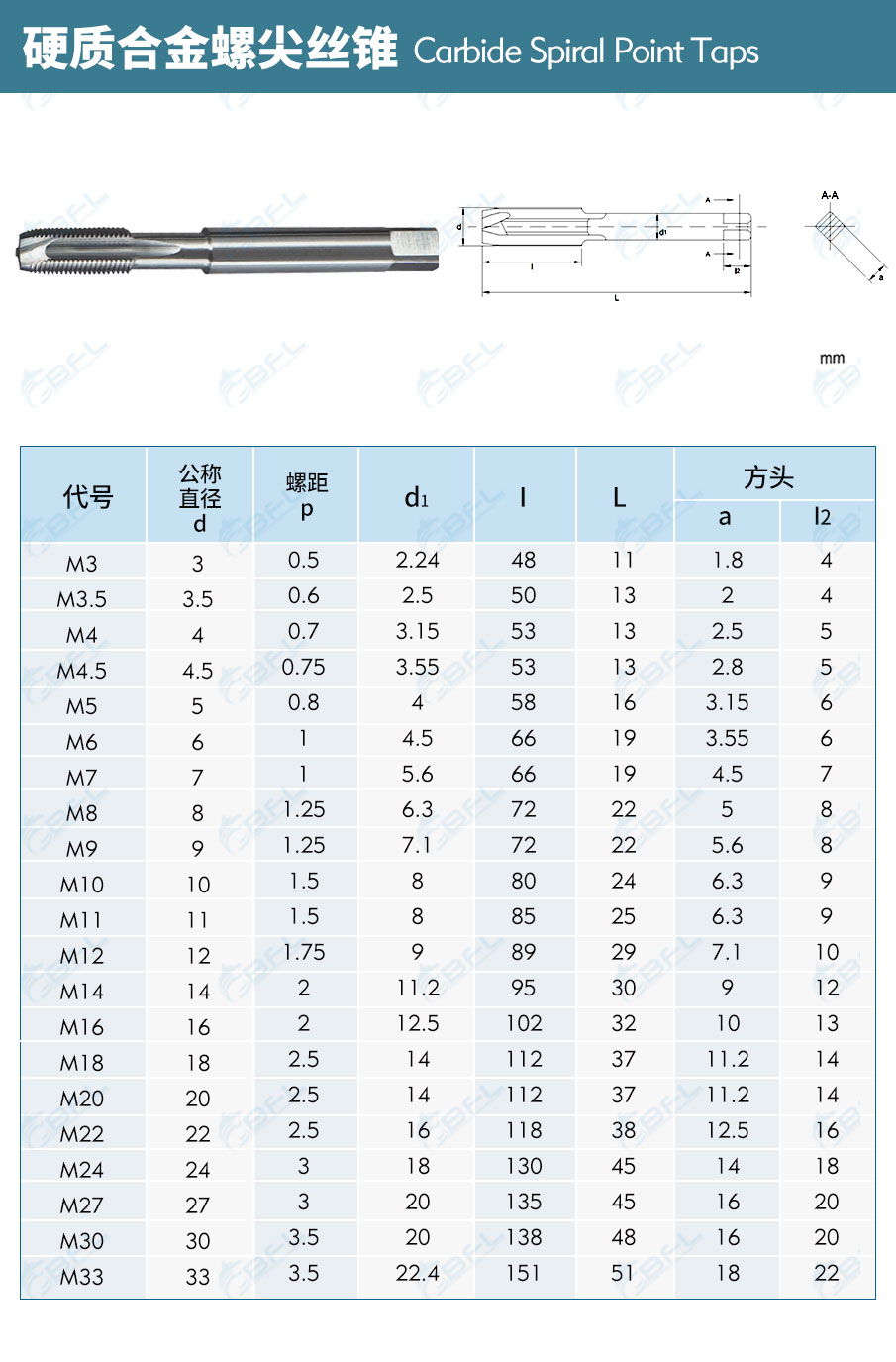
Spiral Flute Taps - High-Performance Thread Cutting Tools for Precision Machining Engineered for superior chip evacuation and extended tool life, our spiral flute taps deliver exceptional threading performance in various materials. These precision cutting tools are ideal for high-speed operations and demanding industrial applications. - Optimized spiral flute design for efficient chip removal - Manufactured from premium carbide for enhanced durability - Available in multiple sizes and thread specifications - Suitable for both through-hole and blind-hole threading
The cool, dense feel of premium High-Speed Steel (HSS) and solid carbide forms the foundation of these threading tools. When you examine the tool under industrial lighting, the precision-ground flutes reveal a specialized surface coating engineered to resist extreme friction and thermal wear. This protective layer acts as a thermal barrier, keeping the cutting edges sharp even during prolonged threading cycles. The geometry features a meticulously calculated spiral angle—available in both regular and high spiral configurations. This specific design actively draws stringy chips upward and outward from the hole. Instead of packing at the bottom and risking tool breakage, the swarf flows smoothly along the flutes. This upward chip evacuation is critical for maintaining clean internal threads and preventing scoring on the workpiece. The sharp, polished cutting edges slice through metal with a consistent resistance, ensuring that every rotation translates into an accurately formed thread without tearing the material, leaving a mirror-like finish on the thread flanks.
Application Scenarios & Machining Performance
These tools are specifically engineered for the demanding environment of blind hole tapping. When working with non-ferrous metals like aluminum, brass, and copper, operators often struggle with long, continuous chips that tend to nest and tangle around the spindle. The spiral flute design completely eliminates this frustrating issue by directing the soft, pliable metal ribbons safely away from the cutting zone. Beyond soft metals, the heavy-duty construction allows these taps to handle rigorous workloads with ease. By significantly extending the operational life of the tool, facilities can reduce the frequency of tool changeovers. This continuous, uninterrupted machining directly translates to lower operational costs and higher throughput per shift. Buyers investing in this tooling solution will notice an immediate improvement in cycle times and a drastic reduction in scrap rates caused by poor thread finishes or broken taps lodged in expensive components. The predictable performance allows for more accurate job costing and scheduling.
Non-Ferrous Specialization: Exceptionally effective on aluminum, copper, and brass alloys.
Heavy-Duty Endurance: Sustains prolonged cutting cycles without premature edge degradation.
Economic Efficiency: Reduces downtime and replacement frequency, optimizing overall production budgets.
Manufacturing Standards & Quality Control
Every single tap undergoes a rigorous journey from raw blank to finished precision instrument. The manufacturing process relies on highly automated CNC grinding centers that shape the flutes and threads with microscopic accuracy. Following the grinding phase, a carefully controlled heat treatment process tempers the steel, striking the exact balance between core toughness and surface hardness. This thermal processing ensures the tool will not shatter under torque while maintaining a bite that lasts. Internal quality control protocols dictate that every batch is inspected for dimensional accuracy, ensuring absolute consistency from the first piece to the ten-thousandth. Furthermore, all dimensions, thread pitches, and tolerances strictly adhere to ANSI and ISO international industrial standards. This universal compliance guarantees that the taps will integrate perfectly into existing tool holders and produce threads that accept standard fasteners without binding or excessive play.
Manufacturing Parameter
Specification & Benefit
Grinding Technology
Automated CNC precision for exact thread profiles
Thermal Processing
Controlled heat treatment for optimal hardness/toughness balance
Global Standards
Full compliance with ANSI and ISO specifications
Quality Assurance
Strict batch testing for absolute dimensional stability
Operational Guidelines & Limitations
To extract the maximum value and longevity from these threading tools, operators must adhere to specific machining parameters. The geometry and material composition are optimized for materials with a hardness rating below 32 HRC. Attempting to thread hardened steels or exotic superalloys exceeding this threshold will result in rapid edge dulling and significantly increases the risk of catastrophic tool failure. When a tap snaps inside a blind hole, the extraction process is notoriously difficult and often ruins the workpiece entirely. Therefore, verifying material hardness prior to operation is a mandatory step. Additionally, utilizing a high-lubricity tapping fluid is strongly recommended. The fluid not only cools the cutting interface but also helps the chips slide effortlessly up the spiral flutes. Proper alignment and rigid workholding are equally crucial; any lateral deflection during the tapping cycle can introduce side loads that these tools are not designed to withstand. By following these straightforward operational guidelines, users can ensure a safe, highly productive threading process that yields flawless internal threads every time, protecting your investment in both the tooling and the final manufactured components.
Changzhou North Carbide Co., Ltd. specializes in R&D, manufacturing, and sales of carbide cutting tools, operating from a modern production base in Changzhou, Jiangsu.